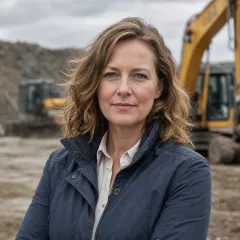
I'm the person who orders equipment, parts, and services for a 40-person construction company. That means I spend a lot of time in search boxes. And I've noticed a strange thing: the more obvious the search term, the more useless the results.
Type 'bobcat excavator for sale' and you'll get a mix of dealer listings, auction sites, and wildlife articles. Type 'water pump' and you'll get irrigation, bilge pumps, and 'which one should I buy?' posts. Type 'crane' and you'll see construction cranes, bird photos, and a long-legged insect called a crane fly. Once I watched a project manager type 'stork vs crane' in the same browser he uses for rental equipment. He wasn't trying to buy a stork. He was checking a bird he saw in the field. The search engine couldn't tell the difference.
This isn't a technology complaint. It's a buying problem.
The Search Box Doesn't Know You're a Buyer
On the surface, the problem is simple: short, vague keywords return mixed results. 'Bobcat' is both a brand and an animal. 'Crane' is a machine, a bird, or a verb. 'Crane fly' is a different term for a long-legged insect. 'Water pump' can mean a dewatering pump, a sump pump, a bilge pump, or the pump inside your building's boiler. 'Bobcat telehandler' is better, but even that phrase gets diluted by dealers who list 'Telehandler' separately without the brand in the title.
People assume the search engine should know what they mean. The reality is search engines only match words. They don't know that when you search 'bobcat excavator for sale,' you're a procurement person with a budget, a deadline, and a muddy job site. So you get animal pictures and bird guides before you get a machine you can actually buy.
Why This Happens: Three Reasons That Matter
1. The same words live in different industries
'Crane' in construction is a machine that lifts steel and concrete. 'Crane' in ornithology is a long-legged bird. 'Crane fly' is a long-legged insect that doesn't lift anything. 'Stork vs crane' is a real bird identification question with a clean answer—they're different bird families. If you type any of these into a search box, the search engine has to guess which world you're in. It guesses wrong more often than you'd think.
The same thing happens with 'bobcat.' Bobcat is a company that makes compact construction equipment. Bobcat is also a wild feline that lives in forests. Search for 'bobcat' alone and you'll see a lot of animal pictures. That's not a failure of the algorithm. It's a failure of the query.
But there's a deeper layer underneath that.
2. Dealer listings don't follow a standard format
Here's something many first-time buyers don't realize: dealer inventory listings are written by humans, and there is no standard format. One dealer might list a 'Bobcat E35 compact excavator.' Another might write 'Bobcat Mini Excavator E35.' A third might just say '2019 Bobcat E35.' If you search 'bobcat excavator for sale,' that third listing may never show up in front of you because the word 'excavator' isn't in the title or description.
Same with 'bobcat telehandler.' Some listings say 'Bobcat TL30 telehandler.' Some say 'Telescopic Handler.' Some say 'Bobcat Loader.' If you only search exact phrases, you miss machines that are sitting on a lot.
This is one reason I stopped trusting search results alone. They're a starting point, not a specification.
3. 'Bobcat' gets used as a generic term
I hear it on job sites all the time: 'We'll move that with the Bobcat.' Nine times out of ten, they mean a skid-steer loader, not necessarily a Bobcat-brand machine. That shorthand is fine when you're standing next to the equipment. It's dangerous in procurement.
When people use 'Bobcat' as a generic word for compact equipment, it weakens the search result for everyone. It also makes it harder to compare machines, because you never pin down the make, model, and configuration. Search results fill that vagueness with the most popular content, not the most accurate content.
What This Chaos Costs You
The first time I got burned, back in 2023, I was looking for a water pump. We needed a 3-inch contractor dewatering pump for a foundation job. I found a quote from a vendor that was $700 less than our regular supplier. The listing said 'water pump' and had photos that looked fine. I didn't ask for the pump curve. I didn't check whether it could handle solids. I didn't even verify the discharge diameter. It clogged on the third day. We had to rent a replacement pump at $480 per day, and we lost two days while the replacement got delivered. That $700 savings ended up costing us close to $3,300 when I counted the rental, the replacement pump, and the crew hours.
That was my assumption failure. I assumed 'water pump' was enough of a specification. It isn't. There are a hundred different pumps in that category. The same is true for 'crane' and 'bobcat.'
In 2024, I had two hours to decide whether to rent a telehandler for a morning job. Normally I'd compare lift charts and delivery fees. Not that day. I went with a Bobcat telehandler from a dealer I trusted, because there was no time to shop around. It worked out, but it taught me that time pressure is not a reason to skip the spec sheet. It's a reason to have the spec sheet ready in advance.
Here's what this search confusion costs:
- Time. I can burn half an hour separating equipment listings from bird articles. Multiply that by every equipment search and it's a real chunk of the week.
- Money. A vague search leads to a vague match. Then you're the person who ordered a pump that can't pump what you need.
- Trust. If you give your field crew the wrong tool, they stop believing you can support them. That's harder to fix than a purchase order.
The deepest cost is the one you can't see: you start to treat every search result with suspicion. And you should. But you also need a better method.
A More Disciplined Way to Search (It's Short)
Once you understand the problem, the fix is boring. I use a few rules now:
- Always include the model number. Instead of 'bobcat excavator for sale,' search 'Bobcat E35 excavator for sale.' Instead of 'bobcat telehandler,' search 'Bobcat TL30 telehandler.' If you don't know the model, call the dealer and ask before you search.
- Add a qualifier for the category. For cranes, search 'mobile crane for construction' or 'overhead crane' if that's what you actually need. For water pumps, search 'contractor dewatering pump 3-inch' instead of just 'water pump.' If you're actually looking for birds, 'stork vs crane' is an interesting search—just understand that the search engine won't know whether you're wearing a hard hat or a birding vest.
- Create a one-page spec sheet for every request. Include machine type, model, year, hours, hydraulic flow, attachment requirements, and any certifications. Send it to vendors, even if they say 'we know what you need.' It prevents mismatches.
- Verify with the serial number plate. Ask for a photo of the serial number plate before you commit. That single step catches more errors than almost anything else.
The goal isn't to become a search expert. It's to give the search engine enough context so it can bring you the right answers. And when you're buying something as expensive as a compact excavator, a telehandler, or a piece of lifting equipment, the right answer is worth the extra ten seconds it takes to type the model number.
I still look up 'stork vs crane' every once in a while, but that's because I like birds and I'm avoiding purchase orders. The difference is I now know the difference. And I make sure every vendor quote has a model number on it before I sign.