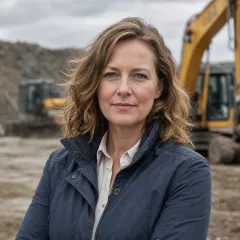
I'm the office manager for a 60-person construction and sitework company, and I handle all of our purchasing—roughly $300,000 a year across 20-plus vendors. If it gets ordered, it crosses my desk first. I report to both operations and finance, which means I get to hear about my mistakes from two different directions.
On a normal Tuesday, that's printer toner, safety glasses, first aid refills, and a recurring debate about which coffee to stock in the breakroom.
In January 2025, my boss asked me to buy a Bobcat compact excavator.
"Sure," I said, the same way I'd say yes to a new filing cabinet. How hard could it be?
I typed "bobcat heavy equipment for sale" into Google and got about 40 million results. Dealerships with no prices. Auction sites with grainy photos of used machines in states I've never visited. One listing that didn't include the year, the hours, or the condition—just a price and a phone number.
That should have been my first clue that I was in over my head.
The machine isn't the hard part
Look, the machine itself is the easy part. Bobcat makes a solid compact excavator, and their dealer network is a big reason people choose them—especially smaller companies that don't have a fleet of in-house mechanics. The hard part is figuring out what you're actually comparing when you get quotes.
I requested pricing from four dealers. Dealer number one answered within a day. Dealer number two was about $4,000 cheaper at first glance. Dealer number three didn't include delivery or the pre-delivery inspection in the price. Dealer number four didn't respond until I'd called twice—which, honestly, should have been my cue to walk—and then made it clear they only had time for fleet buyers.
The $4,000 "savings" from dealer number two evaporated once we added the hydraulic thumb, the freight surcharge, and a few configuration details. The quote wasn't wrong. It just wasn't the price of the machine as we needed it built.
People think expensive dealers cost more because of a fancier showroom or a bigger marketing budget. Actually, it's the other way around: dealers who stock parts, staff a knowledgeable parts counter, and answer the phone can charge more. The causation runs that direction. I didn't see it until our lead operator knocked on my door and asked one question.
One sentence from the guy who runs the machine
"If a hydraulic line blows out on a job site on Tuesday, how long until the machine runs again?"
I had no idea. And neither did he—which was his point. Machines break. Not constantly, and not usually catastrophically, but hoses wear, filters clog, and seals leak. When that happens, the machine sits.
A construction site doesn't pause while you wait for a part to arrive from a central warehouse. Every day that excavator is down, you're either paying for rental replacement equipment or paying a crew to do hand work that a machine would have finished in two hours.
The "buy local" thinking comes from an era when the local dealer was your only realistic source for parts and service. That's changed. What hasn't changed is that parts availability is what keeps your project moving. A dealer with a real parts inventory can usually get you running again within a day. A dealer who orders everything through a regional hub two states over might take two weeks.
I want to say our operator phrased it more politely, but don't quote me on that.
Meanwhile, the rest of my job didn't pause
While I was learning about couplers and bucket capacities, I was also the person Googling "what is the average gpa for a 9th grader" at 11:30 PM, because my own daughter was panicking about a social studies grade. I was price-comparing Skullcandy Crusher ANC 2 headphones for an employee recognition gift (why is that an office manager purchase? Apparently it is). I was chasing an updated certificate of insurance from one of our suppliers.
That breadth is normal in my job. It also means that when an equipment purchase lands on your desk, it lands on a full desk.
The costs that almost ate the budget
For reference: the compact excavators we were considering ran roughly $35,000 to $75,000 depending on configuration (based on dealer quotes from January 2025; verify current pricing). And the machine itself turned out to be the smallest line item in the ledger.
We didn't have a formal equipment procurement process. That's a fancy way of saying I was learning on the job.
I've been here before, sort of. When I took over purchasing in 2020, I ordered from a cheaper vendor because the price was right. They couldn't provide a proper invoice—handwritten receipt only. Finance rejected the expense report, and their mistake cost us $2,400 in rejected expenses. I've verified invoicing capability before every order since then. But a $2,400 mistake in supplies and a $70,000 mistake in heavy equipment are different categories of pain.
Then there were the things I didn't know I didn't know. Our site foreman asked me, two weeks in, who was going to set up the temporary power for the job trailer. "You'll want a GFCI breaker on the temporary panel," he said. He was right—per OSHA 29 CFR 1926.404(b), temporary receptacles on construction sites must be GFCI-protected. It's a small cost and a non-negotiable compliance item.
And then there was the compatibility conversation. The dealer's sales rep said an attachment would be "compatible" with the machine we'd selected. I heard "compatible with the machine." They meant "compatible if you also order the correct coupler configuration." We discovered the difference when the first bucket arrived and didn't fit.
That mistake cost us two weeks of rental on backup equipment and a very tense phone call with our financial controller. The bucket got swapped eventually. The invoice didn't.
What we did, and what I'd tell you
We bought from dealer number one. The price wasn't the lowest. But their parts manager walked through the in-stock list for the model we were considering. He gave us calendar-day estimates for non-stocked parts. He explained the delivery sequence, the pre-delivery inspection, and the warranty registration without me asking. He treated me like a professional, even though I'd clearly never bought heavy machinery before.
That's the thing about a good dealer: your first order doesn't have to be worth seven figures for them to take you seriously. Small doesn't mean unimportant—it means potential. The vendors who took my $200 orders seriously fifteen years ago are the ones I still use for $20,000 orders today.
If you're the person doing this for the first time, here's my short version:
- Compare complete quotes, not base prices. Put freight, delivery, pre-delivery inspection, buckets, and configuration items in the same spreadsheet.
- Call the parts counter before you talk to sales. Ask what's in stock for the model you want. The pause on the other end of the line tells you more than any spec sheet.
- Plan attachments on day one. The excavator is a platform; the attachments are where productivity lives.
- Ask about site electrical requirements before delivery—a GFCI breaker on the temporary panel is a small cost and a real compliance item.
- Get the delivery date, included items, and warranty start date in writing. Not somewhere in the email chain. In writing.
In the end, it took about six weeks from approval to delivery—or rather, closer to seven, counting the bucket fiasco. We got lucky that the learning curve wasn't more expensive.
Buying a Bobcat compact excavator isn't just buying a machine. It's buying into a support network. Choose the network before you choose the price. Your operations manager, your financial controller, and your 11:30 PM Google search history will all thank you.